
Skip to content

Alphablock

    • Intelligence

    • NATURE IS NOT artificial. She iS INTELLIGENT.

    • About
    • Get in touch
    • Sample Page
    • What are you looking for?
    • Workings
Illustration of a bird flying.
  • Arbitraging the anomalies

    Arbitraging the anomalies

    In finance, arbitrage is an essential framework to understand asset pricing. However, the study of anomalies also called as premiums, which are not arbitrageable has led to a debate regarding whether markets are efficient in correcting price imbalances or is inefficiency a reality.

    September 24, 2015
  • Reversion Diversion Hypothesis

    Reversion Diversion Hypothesis

    Information is an assumption for modern finance. The Efficient Market Hypothesis uses information to back its case for efficiency. The EMH case is weak, but as Martin Swell (2011) explains until a flawed hypothesis is replaced by better hypothesis, criticism is of limited value.

    September 13, 2015
  • Momentum and Reversion

    Momentum and Reversion

    Momentum and Reversion have always been seen as independent of each other and never as a composite. This study explains how the two behaviors are not only connected but also get transformed into each other.

    August 22, 2015
  • Markov and the Mean Reversion Framework

    Markov and the Mean Reversion Framework

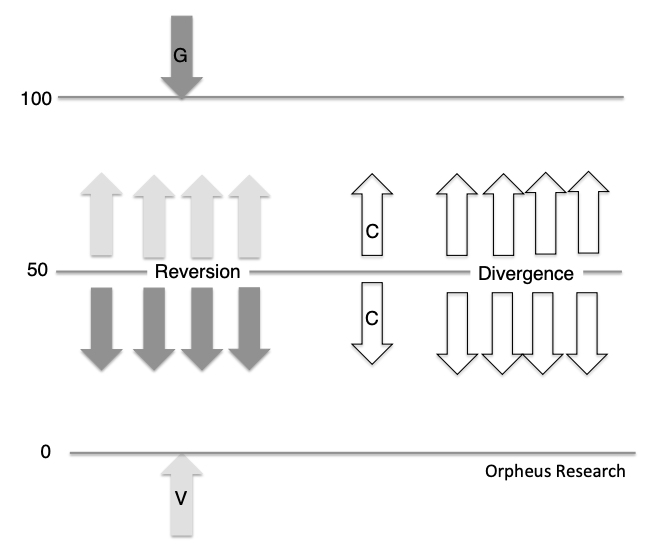
    Natural systems witness reversion and divergence simultaneously across different periods of time. This paper tests the performance proxy as mentioned in a previous paper on the ‘Mean Reversion Framework’ for Markov’s transition probabilities.

    May 26, 2015
  • Mean Reversion Framework

    Mean Reversion Framework

    The original work by Galton on mean reversion in 1886 emphasized relative before absolute, talked about the relation of the variable with the sample average, pointed out the balance between convergence and divergence and showcased cross-domain expression of mean reversion.

    May 15, 2015
  • Winner’s Curse

    Winner’s Curse

    Searching for alpha is searching through inefficiency because there are no supernormal returns in efficiency. This seems intuitive and correct because there is a cost to searching through inefficiency. And agents who spend that cost have to be rewarded for that effort. The case for inefficiency is unassailable.

    April 17, 2015
  • End of behavioral finance

    End of behavioral finance

    I really don’t know why Richard Thaler chose this headline for a research paper. Many other behavioral finance academic papers also capture attention. “Can the markets add and subtract?”; “The winner’s curse”; “The gambler’s fallacy”, “Does the stock market overreact?” While the popularity of the subject has increased and behavioral biases have got so pervasive…

    February 14, 2015
  • Style box, broken or fixed.

    Style box, broken or fixed.

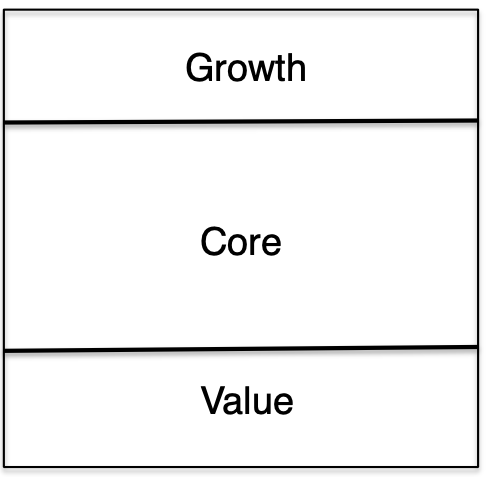
    Style box for the investor is a visual representation of investment characteristics for stocks, fixed income and mutual funds offered as a comparative tool to investors around the world for helping them determine asset allocations based on their risk preference.

    January 15, 2015
  • The Intelligent System

    The Intelligent System

    Over the post-event dinner at the Princeton – UChicago quant conference, the conversation veered to the definition of an intelligent system. My co-speaker (a physicist) from the conference defined an intelligent system as a system that is entropy reducing.

    November 15, 2014
  • Gribbin’s Schrödinger

    Gribbin’s Schrödinger

    Quantum physics may not seem much to have to do with risk and investing, but with subjects like psychophysics explaining the statistical behavior in psychological behavior, it’s just a matter of time that science could explain more of markets. John Gribbin’s biographic work on Schrödinger has a lot of jargon relevant for understanding universal behavior.
    August 11, 2014
←Previous Page
1 … 12 13 14 15 16 … 23
Next Page→

Alphablock

Proudly powered by WordPress